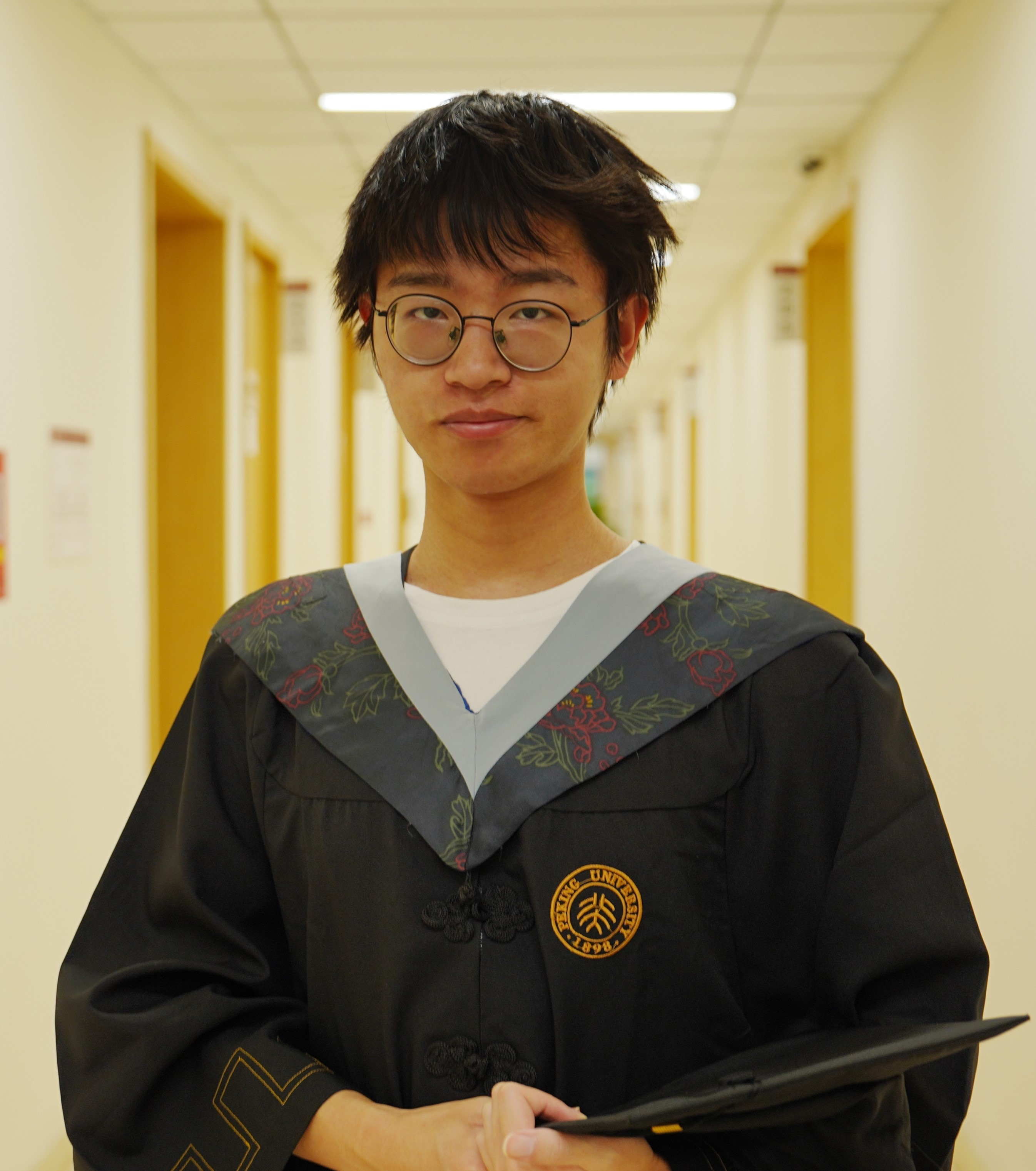
My name is George Ma (Jiangyan Ma). I am an EECS PhD candidate at UC Berkeley, advised by Prof. Somayeh Sojoudi. Previously, I was an undergraduate student at Peking University, where I did research on graph learning at Prof. Yisen Wang’s lab. My email: george_ma@berkeley.edu. My homepage: George Ma’s Homepage.
Dec 2025 – Jan 2026; Evaluating Reasoning Features in Sparse Autoencoders
Studied whether sparse autoencoders (SAEs) isolate genuine reasoning features in large language models. Developed a falsification-based evaluation framework combining causal token injection, LLM-guided counterexample generation, and steering experiments. Conducted large-scale analysis across multiple models, layers, and reasoning datasets, finding that features identified by contrastive methods are predominantly explained by linguistic confounds rather than reasoning computations.
May 2025 – Sep 2025; SpecAgent for Code Completion
Interned at Amazon and proposed SpecAgent, an indexing-time retrieval agent that anticipates future edits in code repositories to reduce inference-time latency. Designed a leakage-free benchmark to avoid future context leakage and provide more realistic evaluation. Experiments demonstrated 9–11% absolute improvements in code completion performance. This work was accepted at ACL 2026 main conference.
Nov 2024 – May 2025; Revising SAE Feature Explanations
Investigated mechanistic interpretability of LLMs using sparse autoencoders (SAEs), which disentangle hidden representations into interpretable features. Proposed structured explanations, a tree-based explainer, and hard-negative sampling to address biases in current methods. The resulting paper was published at NeurIPS 2025.
Dec 2024 – Feb 2025; Normalization Layers and Side-Channel Communication
Studied the role of normalization layers in CNNs and discovered that they enable long-range spatial communication beyond local receptive fields. Analyzed this effect in a toy localization task, showing normalization layers act as iterative message-passing mechanisms. The work highlights risks in applications requiring spatial locality.
Jun 2023 – May 2024; Canonicalization for Invariant & Equivariant Learning
Collaborated with MIT researchers to introduce a canonicalization framework that unifies invariant and equivariant learning. This framework resolved an open problem on the expressiveness of invariant networks with equivariance constraints. We also designed new canonicalization algorithms for eigenvectors, leading to a publication at NeurIPS 2024.
Jun 2023 – Sep 2023; Baking Symmetry into GFlowNets
Interned at Prof. Yoshua Bengio’s lab (Mila) and applied my background in invariant networks to address symmetric actions in GFlowNets. Developed methods to incorporate symmetries into the generation process, improving both diversity and reward. The paper was presented as an oral at NeurIPS 2023 AI4Science.
Oct 2022 – Aug 2023; Laplacian Canonization for GNNs
Explored Laplacian eigenvectors as universal graph positional encodings, which suffer from sign and basis ambiguity. Proposed Laplacian Canonization, a preprocessing algorithm that resolves these ambiguities. The work was published as a poster at NeurIPS 2023.